In the face of wars, resource scarcity, accelerating digitalisation and technologisation, as well as increasing racism and political radicalisation, our understanding of one another, our sense of responsibility and our solidarity are being put to the test. What can empathy achieve in this context?
The exhibition #ifeelyou raises questions about the societal, social and political dimensions of empathy. To answer these questions, we need many different voices. The Kunstmuseum Bonn approaches the subject of empathy through works of contemporary art and a programme of events focusing on encounters and changes of perspective.
Why is this exhibition being held?
Curator Barbara Scheuermann explains
It has been proven that we feel more empathy for people who we perceive to be similar to ourselves. That makes it easier, right? But how do we respond to everything that is unfamiliar to us, where we don’t immediately feel a sense of closeness?
This question, prompted by the crises and conflicts of our time, was my starting point for reflecting on empathy and its expression in art. When we hear the word “empathy”, most of us first think of a feeling: compassion, emotional understanding, perhaps even pity. But empathy is not as reliable as a feeling. Nor is it the same as compassion. And it is also unevenly distributed.
Not everything we perceive triggers the same kind of reaction in everyone – personality, experiences, circumstances and situations all influence our perceptions, opinions and feelings.
We therefore understand empathy here as something that only develops through the interplay of social conditions, media reporting and individual perception. So the exhibition invites visitors to reflect not only on what we feel, but also on how such feelings and fields of perception come into being in the first place.
How does what we perceive as the reality of others actually come about? What role do the media, images, narratives and our own experiences play in this? When do we empathise, when do we feel responsible, what escapes our attention, and why?
The exhibition brings together works of art that engage with these questions in various ways. They can make it possible to experience how perception arises, how it shifts and changes, and where its limits lie – and they offer the opportunity to continually reassess and redefine our own relationship with what we see.
What does empathy mean in this exhibition?
Empathy is not a clearly defined term, but rather the subject of a broad social, academic and theoretical discourse. Depending on one’s perspective, it is understood and defined in different ways.
Empathy is often primarily understood as a cognitive ability: that is, the capacity to identify with the thoughts and perspectives of others. The focus here is on shared thinking. Other concepts of empathy place greater emphasis on the emotional dimension and see empathy as shared feeling – that is, as an emotional response to the experiences of others. And many people ask themselves whether, and how, empathy can lead to concrete action and responsibility.
Empathy is neither neutral nor equally distributed. This poses a major challenge not only for our thinking about empathy, but also, more broadly, for our interactions as human beings. Empathy often develops more easily with people we perceive as similar to ourselves and remains limited with those we perceive as strangers. Against this background, empathy can also be seen as an attitude: a conscious decision to engage with other perspectives, regardless of whether we feel compassion at that moment.
In this exhibition, empathy is understood as the ability and willingness to see things from another person’s perspective – to share their thoughts and experiences – without entirely abandoning one’s own position. Empathy is therefore an active form of perception that requires attention, imagination and the capacity for reflection.
Alfredo Jaar
* 1956 in Santiago de Chile, lives and works in Lisbon

Alfredo Jaar, The Sound of Silence, 2006
Software Design: Ravi Rajan, Installationsansicht HangarBicocca, Mailand, © VG Bild-Kunst, Bonn 2026
In his work The Sound of Silence (2006), Alfredo Jaar engages with the photojournalist Kevin Carter and his photograph depicting a dying child and a vulture in Sudan. For eight minutes, the work tells the story before the press photograph lights up for a moment.
One question is central to the literature on documentary photography: can a photograph really convey suffering, or does an image always create a distance between the subject and the viewer? Nowadays, we see so many images of environmental disasters, wars and accidents on billboards, on social media and television that we often filter out the grief depicted in a photograph. Since the advent of deepfakes (realistic images generated by artificial intelligence), when we see an image, we first have to ask ourselves whether it is genuine and whether it really shows what it appears to. Were you familiar with Carter’s photography? Did you know that it depicts the famine caused by the civil war in Sudan? Many people know the famous photograph without having considered its background.
Alfredo Jaar’s work goes beyond the picture to tell its story. Can art that does not show pictures evoke empathy more easily than art that does?
Studies by the Massachusetts Institute of Technology show that the human brain processes images within milliseconds. This means that they provoke an emotional response from viewers before they can even decide whether or not they want to look at the image. You could say: emotion is faster than reason. People can take advantage of this fact and make deliberate use of emotional images to sow division
@thomasbunn00
8 month ago
„There is a reason most journalists are called vultures. They make their living off the misery of others."
In the constant stream of images that make up our contemporary world, empathy can help us avoid becoming desensitised to them. It can make us think about what we see, distinguish between right and wrong, and take action when we can.
@magnoonmomma
3 days ago
„It’s because of his photo that people now listened and realized how horrendous things were! No one was paying attention before his photo was published. He saved lives with this one photo and had no idea he was considered a hero for finally sharing with the world how awful things were and they were desperate for help."
There are only a few studies on the extent to which empathy is inherited or learned. Some neurobiological studies, however, conclude that around 50 per cent of our capacity for empathy is hereditary. A particular role is attributed to the oxytocin receptor – the so-called “cuddle hormone”.
You could say: empathy is neither fully learnable nor predetermined – rather, it is formed through a process. Respect means taking another person’s position seriously without having to adopt it or fully understand it. What matters is not similarity, but the willingness to remain in conflict – and thus in connection – without immediately resolving it. The decisive factor is therefore not to overcome preconceptions, but to make them conscious, visible and thus open to negotiation. Precisely because perception and judgement are never neutral, solidarity cannot be based on “pure” empathy alone but needs to develop beyond these influences. The author and historian D’Souza argues that empathy should not be seen as a prerequisite for solidarity. Responsibility should not depend on it: political and ethical action should also be possible where understanding reaches its limits.
How do we deal with the imperfection of our empathy?
“Empathy can do no more than dwell on another person’s misery, misfortune and unhappiness. And immersing yourself in someone else’s life and feeling what they feel also means losing sight of the bigger picture. It narrows your perspective rather than broadening it, and out of sheer empathy, you fail to ask the uncomfortable questions” (Caroline Würfel, author and journalist, translated from the German).
In 2022, the neuropolitical philosopher Liya Yu wrote about “empathy burnout”: by being intensely involved, people can become exhausted and end up unable to see things clearly. People who separate themselves more sometimes have a better grasp of the bigger picture. So separation and respecting one’s own boundaries can sometimes also serve the good of the community.
In this context, the Spanish psychiatrist Luis de Rivera refers to “ecpathy” – the conscious counterpart to empathy. Ecpathy describes a form of emotional separation as a means of self-protection. It does not presume indifference or a lack of empathy, and is intended to help people separate themselves from the intense emotions of others and to recognise and resist emotional manipulation. In social or medical professions (e.g. for doctors or nurses), ecpathy can be an important skill when it comes to remaining composed and focused in challenging situations.
To this day, people debate whether Carter should have helped the child instead of taking the photo. Some people, like this Instagram user, believe that Kevin Carter made a positive contribution through his photography. Can raising awareness of a problem be more important than a human life?
In some situations, rational and emotional factors compete: Various philosophical scenarios, such as the so-called trolley problem, raise the question of whether a human life can be sacrificed to save multiple individuals. Most people find it theoretically right to save more lives. However, if they had to actively push a person in front of a moving car to save others, they would not do it. So can compassion and morality also contradict each other?
Hans Hemmert
1960 in Hollstadt - 2025 in Berlin
Hans Hemmert, level (2m groß sein), 1997
Installationsansicht Galerie Gebauer Berlin 1997, © VG Bild-Kunst, Bonn 2026
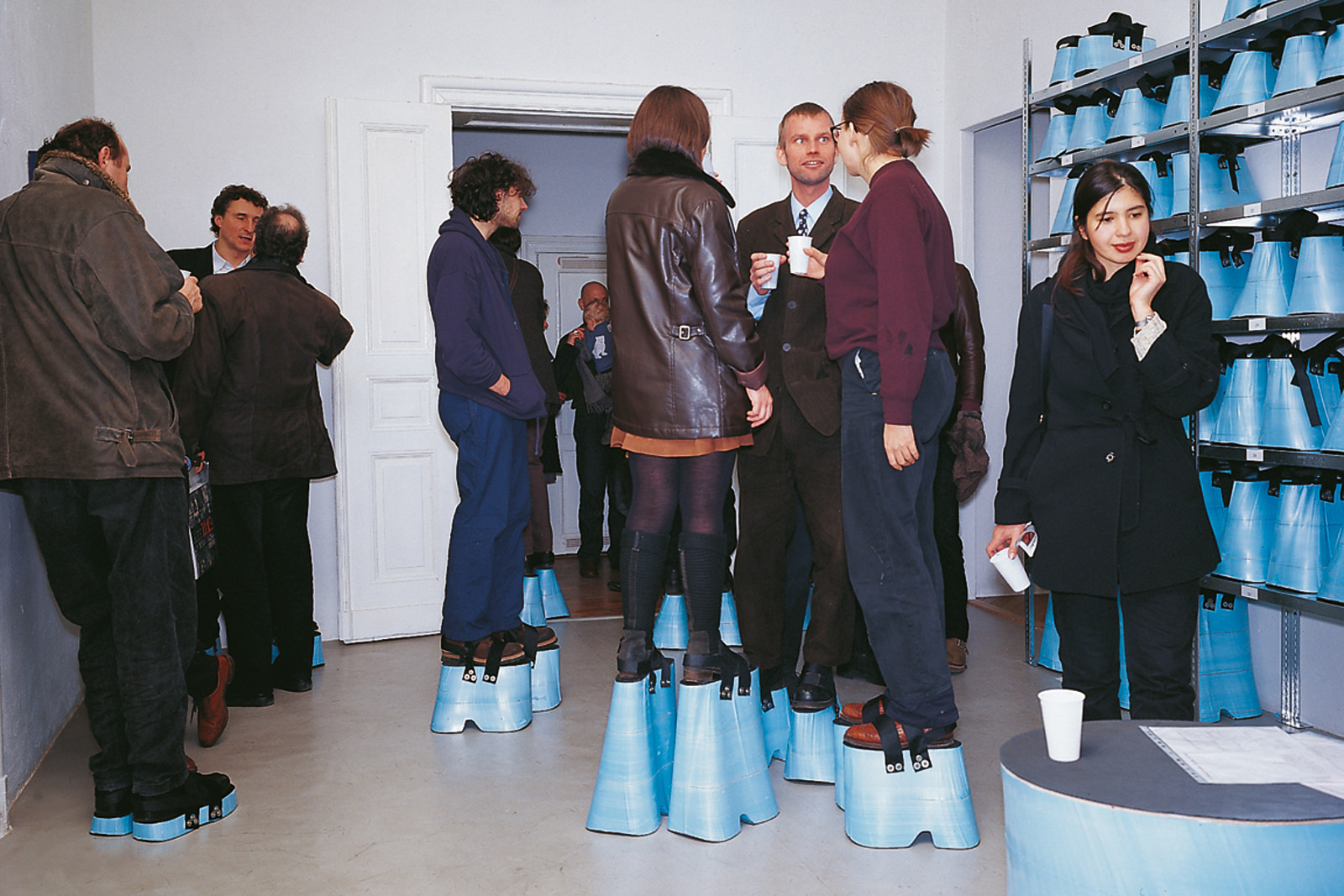
In 1997, Hans Hemmert designed platform shoes of various heights that enable people of varying statures to be, quite literally, at eye level.
The philosopher David Lauer (Christian-Albrechts-Universität zu Kiel) sees more potential in recognition than in empathy:
“Recognition requires that we treat each other as peers, meet each other at eye level, confront each other with our expectations, and strive to meet the expectations of the other person.” (translated from the German)
Whether we are met at eye level depends, among other things, on our actual eye level – that is, our height. Respect and authority play a crucial role here. Although the evolutionary advantages of strength and height in hunting, fighting and finding a mate no longer serve any purpose today, this perception remains persistent.
The image of “being at eye level” suggests that we do not respect each other if we do not have the same bodies or are not the same height. Tall people are often grown men for whom other people have seemed physically inferior since their youth. Due to their height, for example, they experience less provocation and humiliation in the school playground, and take this sense of security with them into adulthood as self-confidence. This “natural authority” is later equated with respect and a sense of responsibility. Taller people find it easier to climb the career ladder. They are seen as more competent and charismatic. This often results in what is known as a self-fulfilling prophecy: despite being equally competent, people with “attractive”, “normal” bodies and more self-confidence are preferred.
Can empathy help us feel the same amount of respect for everyone?
The way empathy is expressed has a lot to do with respect. If it is not “at eye level”, the desire to help others can lead to the person’s wishes and boundaries being disregarded. Respect, on the other hand, is also possible without empathy. In this situation, the question arises as to what basis we have for respecting other people, if not because we are able to put ourselves in their position.
When we know what challenges and barriers other people face and take the urgency of these seriously, it motivates us to bring about change.
Claudia Robles-Angel
* in Bogotá, lives and works in Cologne
Claudia Robles-Angel, Reflexion – In Sync/Out of Sync, 2019-2026
Installationsansicht MM Gerdau Museum, Belo Horizonte 2020/2021, © Claudia Robles-Angel und VG Bild-Kunst, Bonn 2026, Foto: Lucas D’ Ambrosio
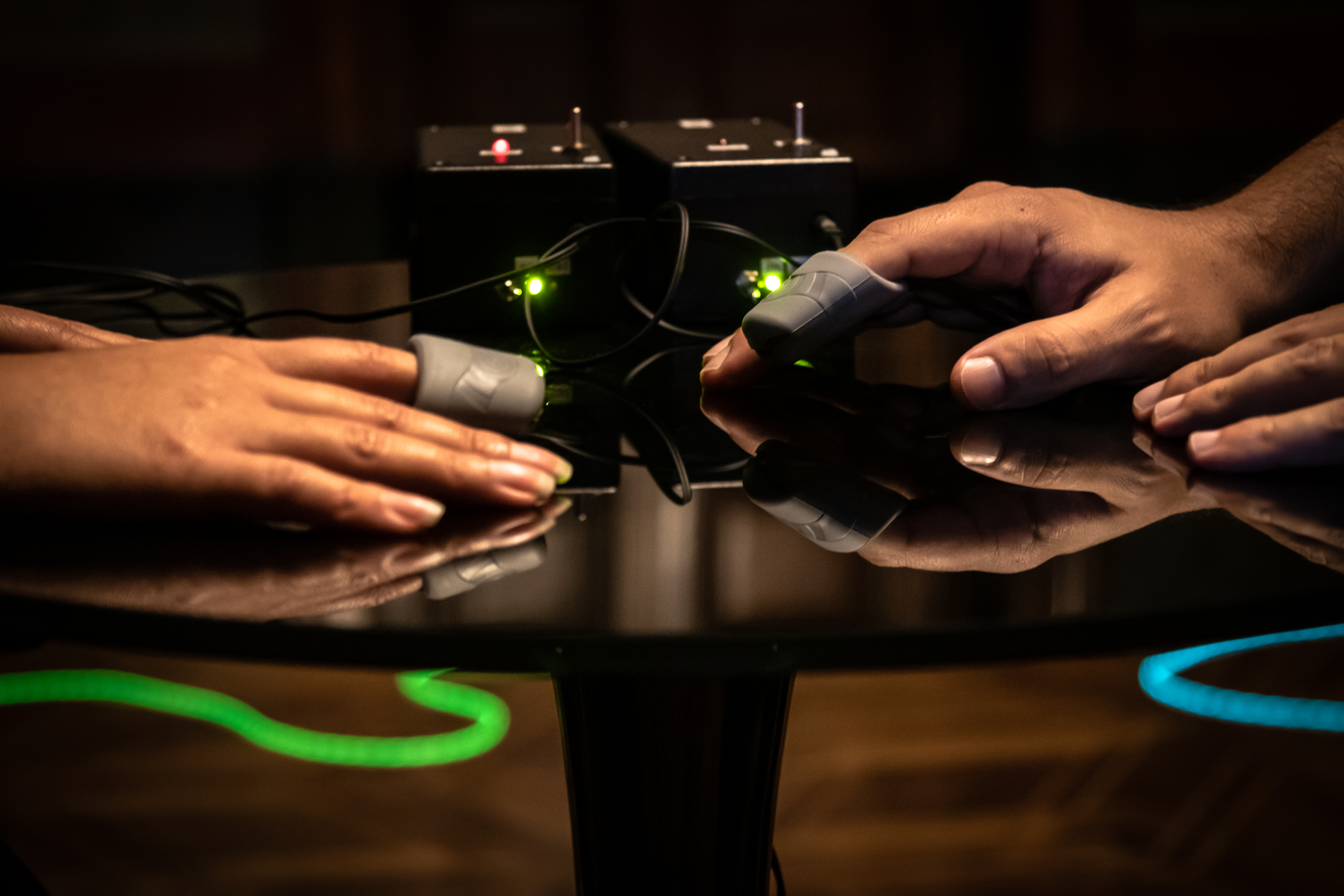
Using pulse oximeters attached to their fingers, REFLEXION In Sync / Out of Sync (2019–2026) transmits the heartbeats of two participants into the space as an interplay of light and sound. The work is based on the physiological effect whereby emotional connectedness causes heartbeats to synchronise.
According to the psychiatrist Pablo Hagemeyer, when people spend time together, they automatically develop an interest in what the other person’s facial expressions and body language mean. So it is human nature to try to put yourself in someone else’s shoes. Some people adapt quickly to each other, whilst for others, questions and conversations help to create a shared mood.
What interpersonal significance can be attributed to the phenomenon of two people’s heart rates synchronising?
"Changes in pulse are a good indicator of changes in physiological arousal. Synchronising heart rates can therefore mean that people are relaxing together or becoming nervous together. Perhaps they are both experiencing the same emotion at that moment, or one person is affecting the other with their excitement or calmness. Yet the starting pulse of two people can vary greatly, for example because they have different levels of fitness. Then the physiological arousal of one person has to increase and that of the other person decrease until they meet in the middle. The effect is therefore underpinned by an interplay of mutual perception, emotional states and individual physiology" (Leon Skottnik, neuroscientist).
When does this effect work particularly well?
"It works particularly well when both people have a similar starting pulse and react to the situation in a similar way. However, if one person is particularly excited or relaxed, it can also be contagious. Paying conscious attention to emotionally relevant signals, such as breathing patterns or a smile, can help. If you want to consciously adapt your own pulse, experience with breathing techniques or mindfulness can help" (Leon Skottnik, neuroscientist).
How is the synchronisation of heartbeats related to empathy?
"The relationship between empathy and heart rate or physiological arousal is complex and varies depending on the person and the situation. One important connection could be what is known as mirroring. In this process, the brain automatically imitates the bodily signals of others. In addition, our brain simulates the emotional state of the person we are interacting with. These two processes can be instrumental in the relatively automatic alignment of emotional states and levels of arousal. More flexible processes interact with these automatisms and ultimately form a multi-layered emotion: empathy" (Leon Skottnik, neuroscientist).
Fritz Breithaupt, the author of “The Dark Side of Empathy” (2017), argues that empathy is temporally limited. It is exhausting, which is why there needs to be an end in sight. People with chronic illnesses often receive less and less empathy over the course of their illness. Can we learn more empathy endurance?
Boris Mikhailov
* 1938 in Charkiw, lives and works in Charkow and Berlin
Boris Mikhailov, Case History, 1997/98
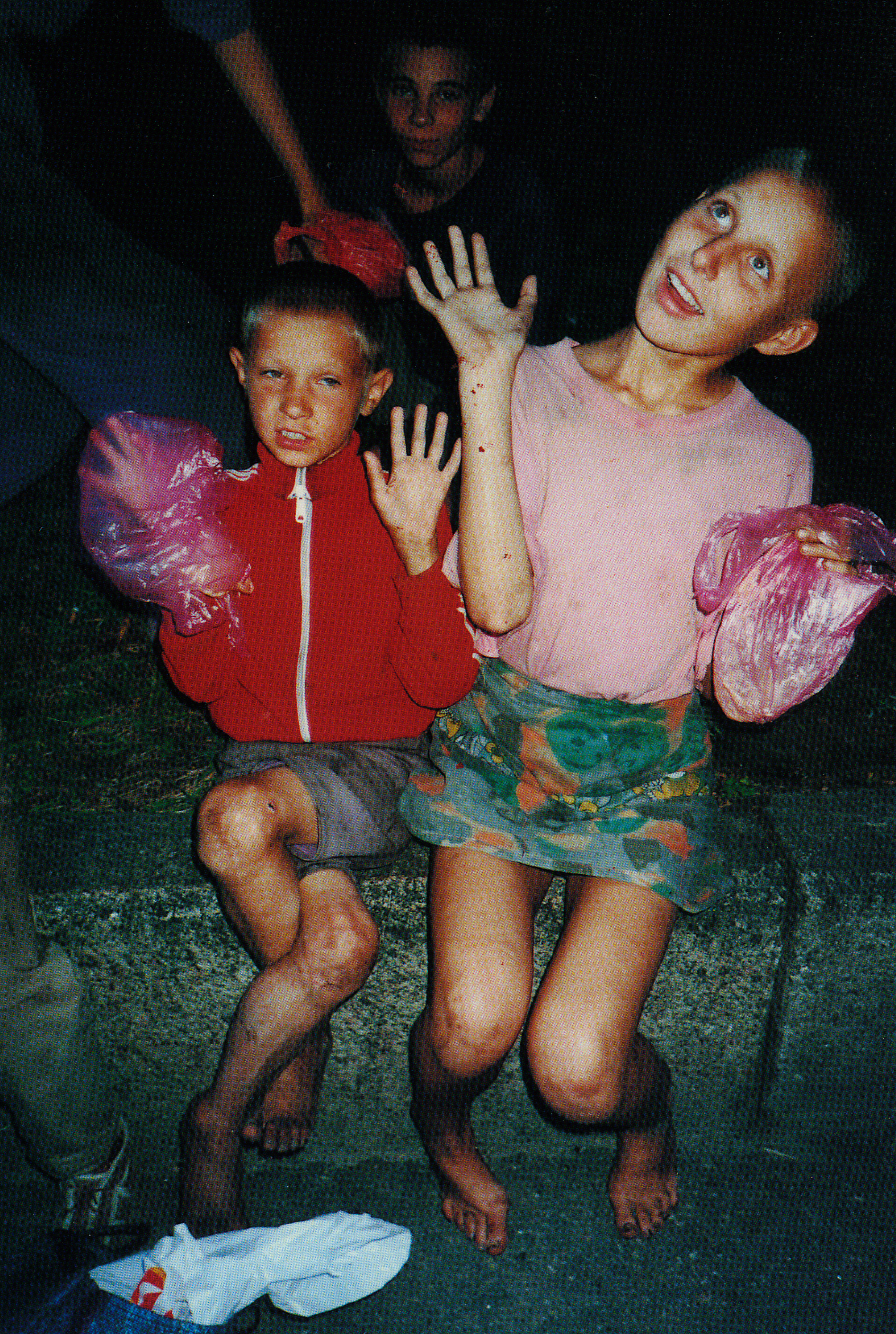
The more than 400 photographs in the series Case History (1997–99) show people who became homeless in the wake of the collapse of the Soviet Union.
Boris Mikhailov sees himself as a documentary photographer and is interested in new, previously unseen images. Instead of documenting neutrally, the photographer pays and instructs the individuals portrayed. In this way, he depicts scenes that highlight the realities of life following the societal collapse.
Mikhailov's photographs were taken in what is now Ukraine, and nearly 30 years after they were taken, they have regained particular relevance. The empathy for those affected by the ongoing war of aggression in Ukraine is strong.
People in Germany generally express solidarity with the Ukrainian people; however, this attitude does not appear to be consistent. In an interview with MiGAZIN, Vladyslava Vorobiova, a board member of the Ukrainian-German association Vitsche, reported that, following the power cut in Berlin, solidarity with and understanding for the people of Ukraine increased. Experiencing a situation yourself is more powerful than simply imagining it. The journalist, podcaster and author Jasmine M’Barek argues that a literal “I feel you” – actually feeling the situation of the other person – is hardly possible, because a white woman, for example, cannot feel exactly the same as a black man.
Full empathy goes beyond the emotional (and often publicly displayed) “I feel you”. To treat other people with empathy, we do not need to be able to fully understand their situation. By listening to their views and feelings, and by trying to put ourselves in their position, we can develop a better understanding and, consequently, greater empathy.
In the 17th century, the philosopher Thomas Hobbes wrote that, without state control, people would be prone selfishness and criminality. He maintained that people would only stop being selfish through socialisation. There are now many studies that demonstrate the opposite: during disasters, most people are rescued by other people who are also affected. On 11 September 2001, 40,000 doctors voluntarily offered their help. When an earthquake struck Mexico City in 1985, 2.8 million people took part in the rescue operation.
“In emergency situations, the best in people comes to the fore. I know of no other sociological insight that is so well documented and yet so completely ignored. The image portrayed in the media is diametrically opposed to what actually happens in the aftermath of a disaster” (Dutch historian Rutger Bregman in Deutschlandfunk, translated from the German).
Studies show: altruism is contagious. People who see others being helped are much more likely to help others themselves. According to the journalist Andreas von Westphalen, when people see someone else making a donation, their own willingness to donate increases by 150 per cent. Moreover, the behaviour of one person not only affects the behaviour of one other person, but also that of the people around them.
Mikhailov’s role as the photographer of these scenes is ambivalent. The camera’s perspective can be understood as critical, honest, respectful, or even sensationalist or indifferent. The intersection of documentary and visual art raises many questions about how to deal with the vulnerability of those depicted and the audience’s gaze.
What differences arise through the perspective of photography?
In one section of the exhibition, the Verein für Gefährdetenhilfe e.V. (VFG - Association for Helping People at Risk) responds to the theme of empathy. Clients of the association present themselves as they would like to be seen in the play “Loreley gesucht”, choosing the photographs and the manner of presentation.
The play will be presented at the Kunstmuseum Bonn on June 21, June 28 and July 5, starting at 3 p.m. For more information, please visit our website calendar and the exhibition website.
Katharina Mayer
* 1958, lives and works in Dusseldorf
Katharina Mayer, Getürkt, 1992
© VG Bild-Kunst, Bonn 2026
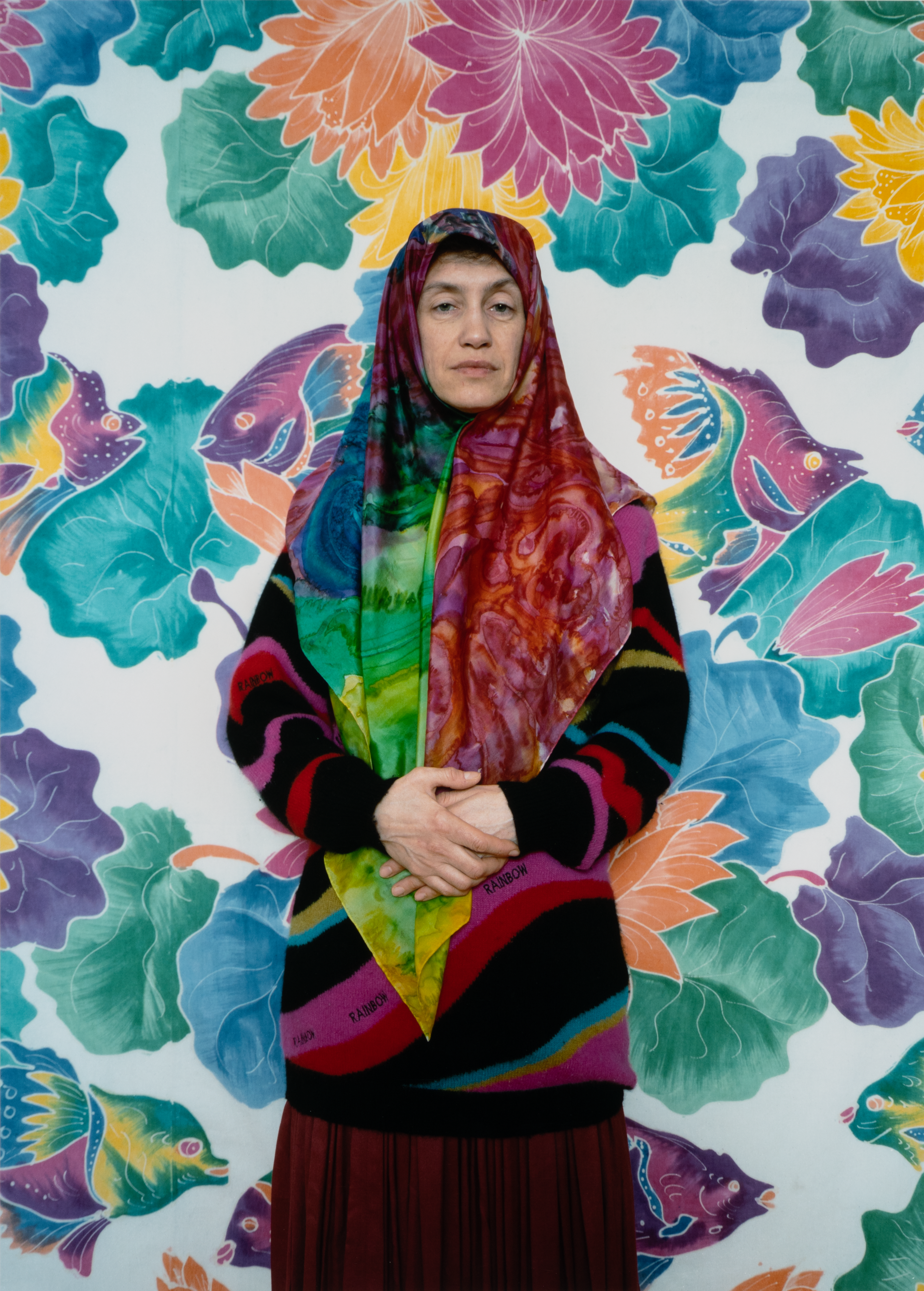
The series Getürkt comprises over 100 portraits of women wearing headscarves, posing in front of brightly coloured fabrics. Documentary observation and staging are combined here. This raises questions about how such images come about and how notions of identity, attribution and “authenticity” shape our perception and perspective.
“At first, I decided to photograph female friends and acquaintances wearing veils and reproduced what I had already observed, which was very insightful: my ideas about the pictures mingled with those of the women photographed and with their respective views on the subject. When someone made the critical comment: “I don’t want to be a model for the stereotypical image of a Turkish woman at a Gelsenkirchen flea market” I realised that wasn’t what I wanted either. I did not want to create a caricature of a negative image of these women, but rather a serious and phenomenological presentation of a subject. The result is a series of over 100 colour portraits of women, who are depicted either veiled or unveiled, regardless of their nationality or religious affiliation” (Katharina Mayer on Getürkt).
So-called cultural markers, such as the headscarf not only indicate belonging but also influence our perception and our judgement. By creating distance or closeness, or by triggering certain expectations, they can direct our empathy. In her book The Politics of the Veil, the author Joan Wallach Scott demonstrates that such symbols are socially charged and are not merely expressions of “authentic” identity but also serve as surfaces onto which ideas about the self and the other are projected.
Joseph Beuys
1921 in Krefeld - 1986 in Dusseldorf
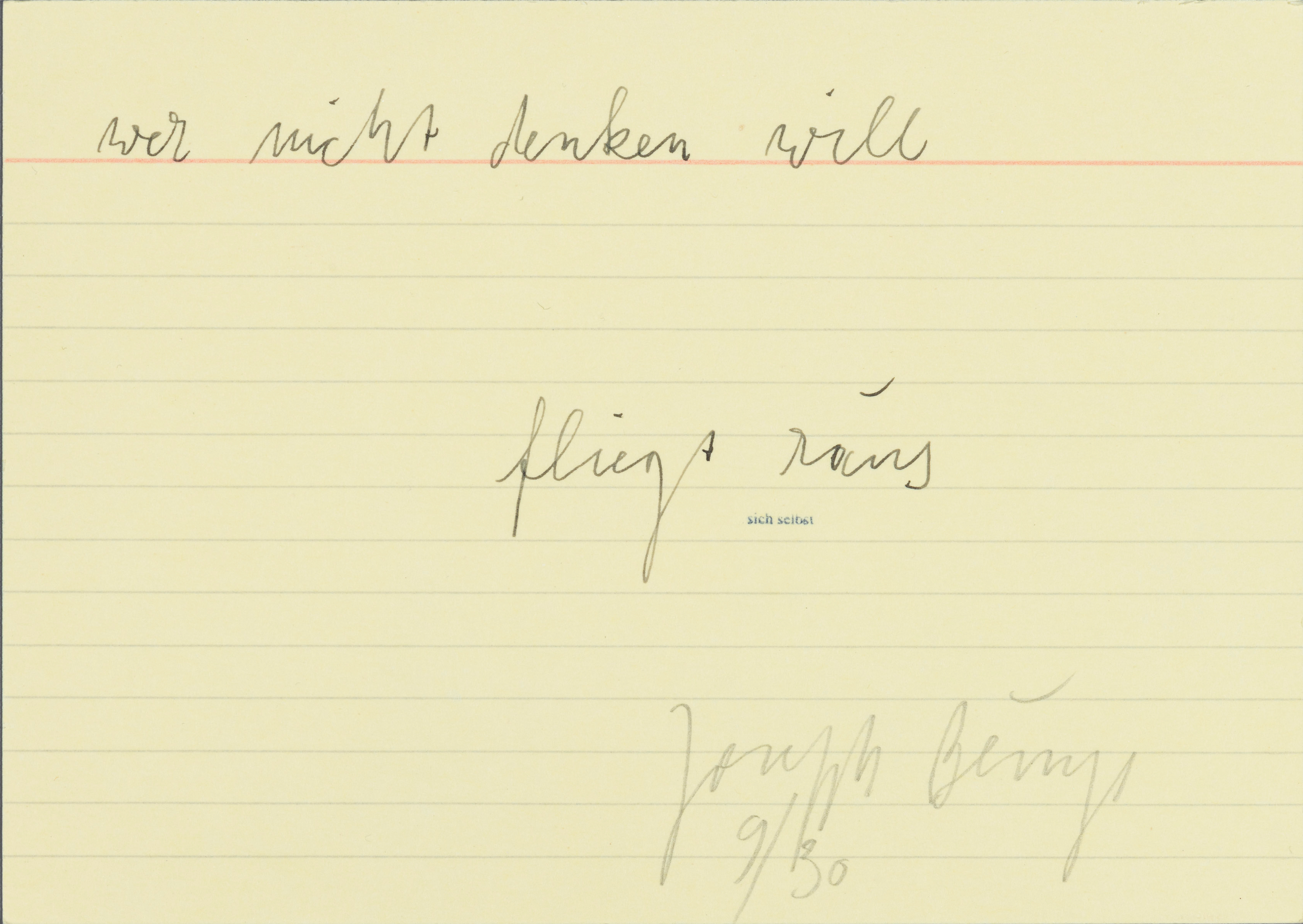
Joseph Beuys, wer nicht denken will, 1977
Kunstmuseum Bonn, © VG Bild-Kunst, Bonn 2026, Foto: Reni Hansen
Joseph Beuys is one of the defining figures of 20th-century art. With his expanded concept of art, he described it as a social process. According to Beuys, everyone can play a role in shaping life socially and creatively, especially in politics and economics.
In Partei der Tiere (A Party for Animals), Beuys envisions a symbolic counter-order to human society. Empathy extends beyond human beings. Animals are considered as political subjects. Mensch Selbstbestimmung (Human Self-Determination) formulates the demand for individual freedom as a prerequisite for social participation – and at the same time as the responsibility of every individual. In Wer nicht denken will, fliegt raus (Whoever Won't Think, Gets Kicked Out), Beuys presents thinking itself as a social obligation. For Beuys, thinking is already a form of action. Here, empathy is not seen as a feeling, but as a prerequisite for actively shaping social processes.
From around 1967 onwards, Joseph Beuys coined the term “social sculpture” within the context of his expanded theory of art. He no longer saw art as being limited to objects, but as a much more open field encompassing thinking, speaking and acting – in short, everything that shapes social processes.
Society is understood as an open structure that can be transformed through communication and relationships. Every human being is involved in shaping this “sculpture”. “Every human being is an artist” (Joseph Beuys).
Ulf Aminde
* 1969 in Stuttgart, lives and works in Berlin

Ulf Aminde, Frontalunterricht, 2009
Courtesy of the artist and Galerie Tanja Wagner, Berlin
Frontalunterricht (classroom teaching) emerged from a theatre workshop with young people who initially refused to cooperate with the artist. It was only when the artist asked the group to play him on stage in front of a running camera that the situation fundamentally changed. The young people began to take on Aminde’s role, imitating him and commenting on him – the play took shape at the moment of this reversal of roles.
From an early age, role-play is one of the central methods of childhood education and forms part of everyday play. Role-play stimulates the imagination as well as important social, emotional and cognitive skills. This also includes empathy. By taking on another role, children are able to put themselves into different worlds and develop empathy and understanding.
And yes, adults also learn through observation and imitation. In this way, empathy can be learnt or unlearned. So, when we actively put ourselves in another person’s position and act accordingly, we strengthen our own abilities and those of the other people involved. However, this also works the other way around: according to Professor Grit Hein, an environment with little empathy can influence an individual’s ability and willingness to empathise. An increase in power is also demonstrably linked to a decline in the ability to read other people’s emotions.
Empathy can be seen here as a two-way process: the artist tried to put himself in the position of the young people but only succeeded once they accepted his invitation to put themselves in his. Aminde relinquishes control here, turning himself into the object and thereby making himself vulnerable. Empathy does not emerge here as a harmonious understanding, but as a critical moment – one that depends on trust and scepticism and carries the risk of losing one’s own position.
Empathy is, by its very nature, one-sided: it is based on the difference in experience and on the fact that one person is affected whilst the other is not. The person who is empathetic may also feel good because they show empathy, thereby demonstrating a social skill.
Ulf Aminde reverses the dynamics between the two sides by letting his students take on the empathetic role.
In diesem Werk ist ein inszenierter Suizid zu sehen. Scrolle und gehe weiter, wenn du dich heute nicht mit diesem Thema befassen möchtest
Eva & Franco Mattes
both * 1976 in Italy, live and work in New York
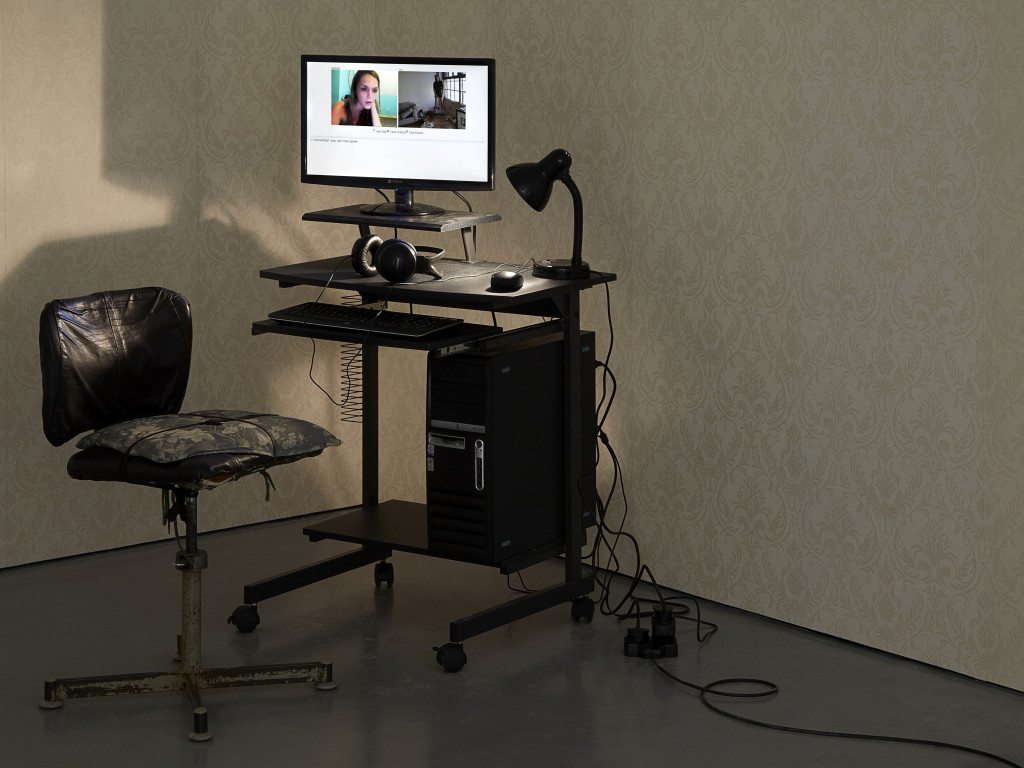
Eva & Franco Mattes, No Fun, 2010
Eva Mattes and Franco Mattes work as an artist duo exploring the conditions of the digital public sphere and online perception. For No Fun (2010) they staged a live situation on Chatroulette – a platform for random webcam encounters – which was later documented on video. In their shared New York studio, Franco Mattes simulated a suicide using a rope for hours while the camera transmitted the event.
Thousands of unsuspecting users thus became spectators of a scene whose authenticity they were unable to gauge. Only a very small number alerted the police.
During the video recording, the viewers themselves were part of the setting: a laptop projected onto the screen displayed their reactions in real time, creating a kind of mirror image of what was happening.
No fun raises questions about the responsibility of observers and points to the need to engage critically with media images.
How do we deal with people whose words or actions do not align with our ideas of empathetic coexistence? Can we reconcile this with our moral boundaries? Is it acceptable to leave the chat room quickly? Or to use the situation to stage yourself?
“A responsible exploration of guilt—one that neither excuses the perpetrators nor forgets the victims—is only possible through an empathetic approach. In this context, empathy does not mean pity or sympathy, but rather the practice of careful observation and self-reflection. It is both emotional and reflective. Not an offer of identification, but a method of understanding. It allows us to combine understanding with criticism: we can try to see things from different perspectives without condoning the behaviour.
An empathetic approach prevents demonisation and reveals the social structures that enable guilt” (Dr. Saskia Fischer, Leibniz University Hannover, 2025, translated from the German).
Furthermore, Eva and Franco Mattes’s internet performance calls into question their own role on the internet, as the performance knowingly exposed random chatroom visitors to traumatic experiences.
Social media is often seen as a “polarisation machine” – a space where anonymity leads to blunt criticism and algorithms reinforce extreme views. The psychotherapist Pablo Hagemeyer has observed that people unlearn empathy through their digital interactions on social media.
"The digital space is not a space without consequences – real people with real feelings meet here. However, social media is designed to provoke impulsive reactions. We need to learn to resist these impulses and communicate with one another mindfully. To show digital courage when others are being harmed and take fundamental rights seriously – both your own and those of others. Role models in schools, youth work and society should lead responsibly by example" (Matthias Schaar, Evangelisches Jugendwerk Sieg • Rhein • Bonn (Evangelical Youth Organisation Sieg • Rhine • Bonn), translated from the German)).
Candice Breitz
* 1972 in Johannesburg, lives and works in Berlin
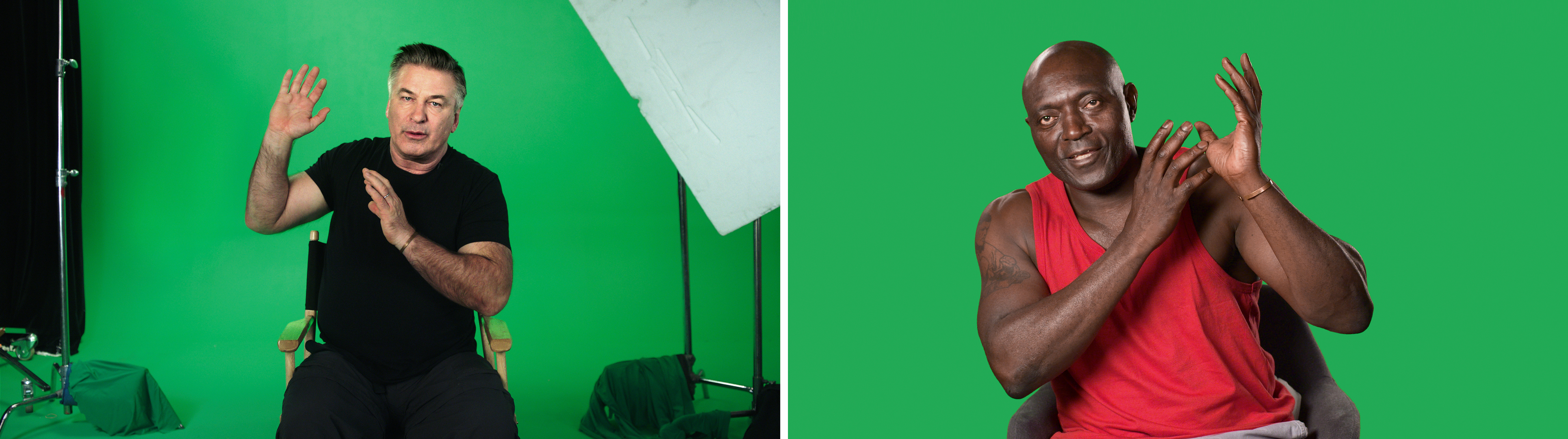
Candice Breitz, Love Story, 2016
Courtesy Goodman Gallery, Kaufmann Repetto + KOW, © Candice Breitz
The installation Love Story (2016) covers two rooms. Different people talk about their migration experiences on camera.
Neuroscientific studies show that empathy is activated particularly strongly towards so-called in-group members – that is, people who seem similar or close to us. If we are only able to empathise with certain people, empathy can cause division and increase discrimination.
The so-called “other-race effect” – which describes the tendency for people to perceive their “out-group” in a less nuanced and emotional way – already starts at the age of nine months. This does not mean that people naturally become racists, but rather that there is a predisposition towards forming emotional groups. If we are convinced that all people are equal, we need to realise that living up to this ideal requires effort. In "Regarding the Pain of Others", the author Susan Sontag wrote: “Compassion is an unstable emotion. It needs to be translated into action, or it withers”.
The “in-groups” with which people share central characteristics are especially present in the digital space. Due to algorithms, we increasingly move within “in-groups”, known as “bubbles”, “filter bubbles” or “echo chambers”.
People tend to take sides. Just as this installation illustrates two sides, empathy or a lack of empathy can also sometimes result in two camps.
Researchers have shown that political enmity can significantly reduce empathy. For example, supporters of opposing political parties often feel less empathy for the suffering of the other group.
The scientist Fitz Breithaupt observes how television reports on crisis or war zones arouse empathy for different groups depending on the viewer. He therefore sees the danger of empathy being so strong that it causes division.
@gildasahebi.bsky.social
The response of a resident of Tehran to the question of what she now expects from the international community:
“Nothing. We’ve never mattered to them. For the international community, the issues of antisemitism are much more important than the suffering of us Iranians.”
So true.
With several global crises and wars raging, aid, attention, understanding and sympathy are not only needed, but also currencies. Who receives how much of what is determined by a complex interplay of reason, morality and compassion.
Nikolaj Bendix Skyum Larsen
* 1971 in Aalborg, lives and works in Paris
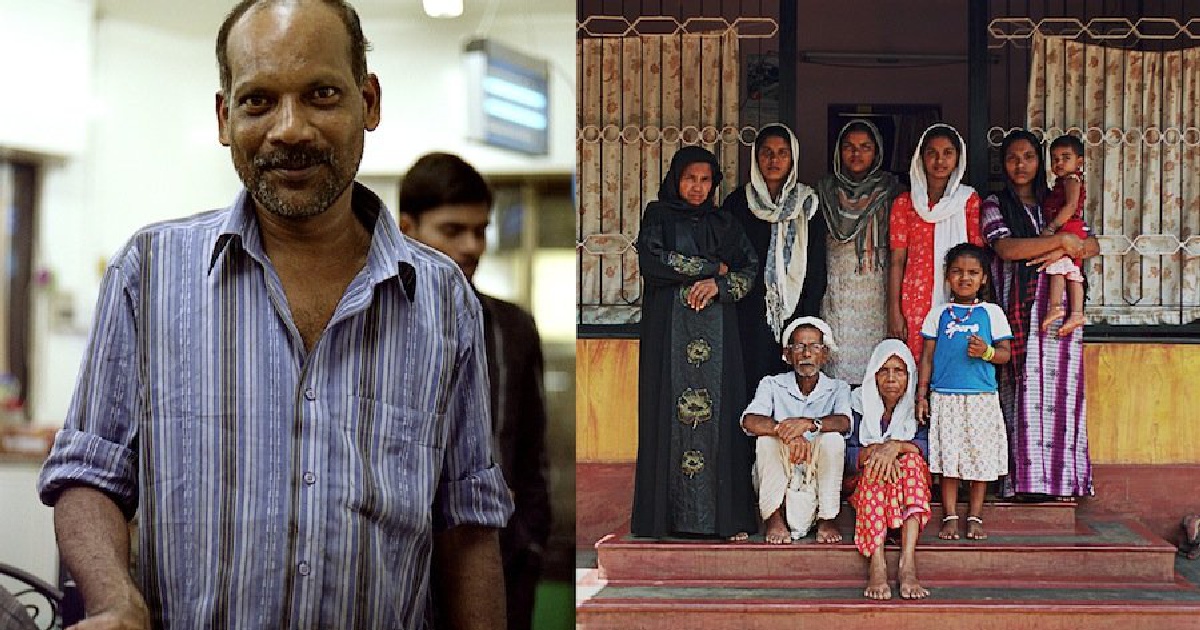
Nikolaj Larsen, Rendez-vous, 2009
© Nikolaj Larsen
Rendez-vous shows Indian migrant workers in Dubai and their families back home in Kerala on opposing projection surfaces. The audience quite literally stands “in between”. This work presents a reason for temporary migration without any sentimentality.
In 2019, the newspaper “Die Welt” stated in an article entitled “Migration ohne Ende” (Migration without end) that both supporters and opponents of liberal migration policy are driven by empathy. Some for the people who immigrate and others for the people who live in Germany and are indirectly affected by immigration. The proximity of the people concerned is an important factor. When our best friend gets into a work conflict, it’s usually much easier to put ourselves in their situation than that of their boss, because we’re familiar with the situation ourselves. This scenario raises the question of how we should deal with the fact that developing empathy can be more or less difficult.
Empathy is processed in the “anterior cingulate cortex” (which is associated with the sensation of pain) and the insula in the brain. When one person dehumanises another – i.e. thinks or speaks of them as though they were worth less than themselves – this part of the brain switches off. This part of the brain is active when we perceive people in categories we also see ourselves as belonging to, e.g. son, father, swimmer, musician. In other words: when we get to know each other and discover similarities, our brains trigger more emotions.
Philipp Gufler
* 1989 in Augsburg, lives and works in Munich
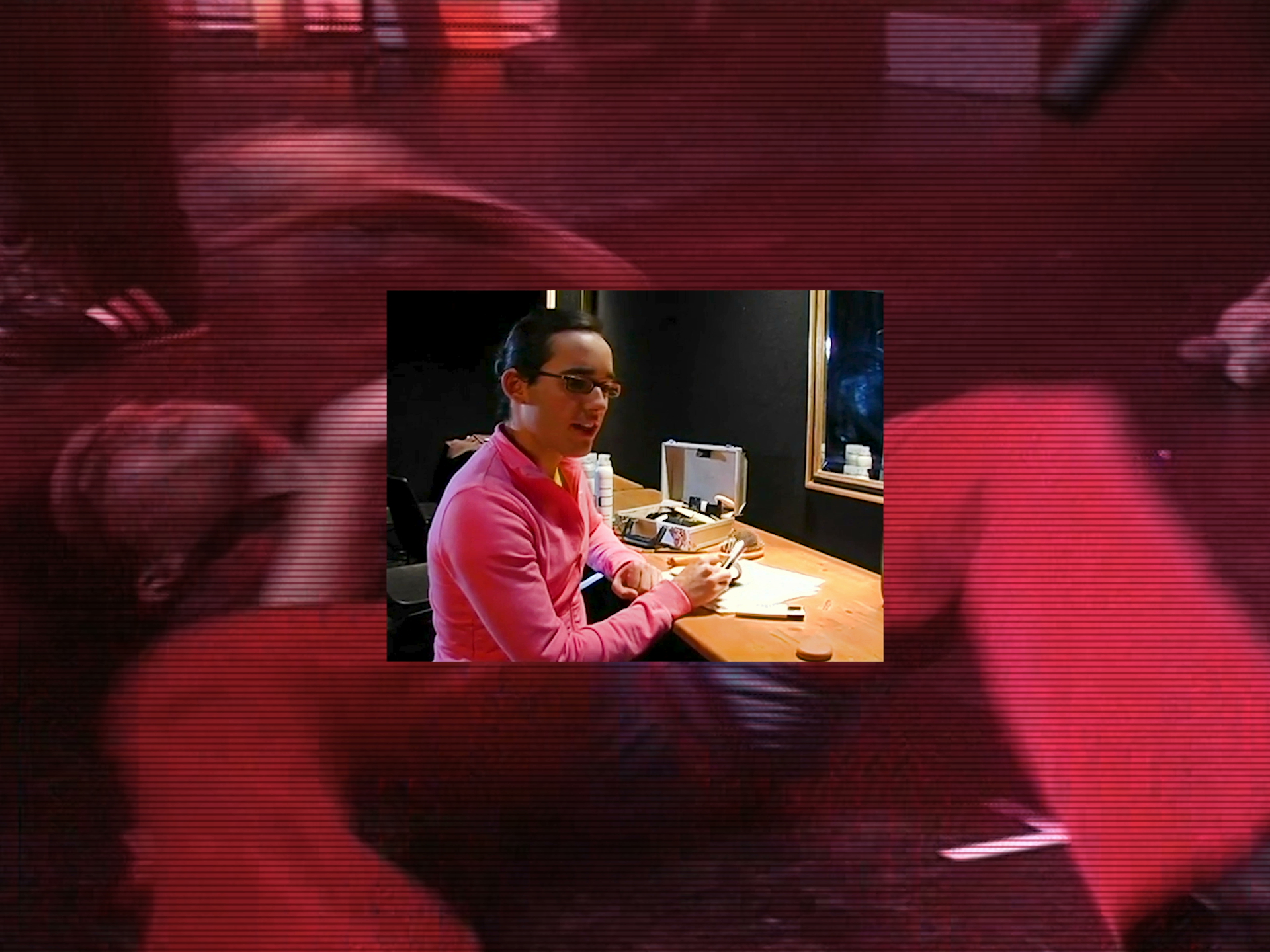
Philipp Gufler, Lana Kaiser (Filmstill), 2020
Courtesy BQ, Berlin, Foto: Roman März
Lana Kaiser (2013) portrays the entertainer of the same name (formerly Daniel Küblböck), who disappeared in 2018, and her role as a dazzling projection surface caught between collective empathy and callousness.
"When I first saw Lana Kaiser on TV at the age of 13, I was struck by her appearance and gestures. It was the first time I saw a queer person refusing to be identified as either male or female. The casting show was Lana's possibility of escaping the countryside in Bavaria. As she was only four years older than me, and also grew up in the rural area two hours outside of Munich, she was someone I could identify with. Going to her concerts was a way to temporarily leave the small, conservative village I was living in. With the rise of the internet in people's homes, I started to visit online chat rooms to connect to other fans of hers. On the reality TV shows, she made herself hyper-visible, and even before the rise of social media, she became a victim of "shit-storms". Seeing her as a teenager on stage at concerts, I realized how much of a toll the pressure of visibility and the refusal to conform were talking on her. As fans of Lana Kaiser, we have faced the same anti-LGBTQ+ hatred on a daily, which has been perpetuated by the media" (Philipp Gufler, translated from the German).
"Lana inspired so many people with her positive energy. I would have loved to tell Lana Kaiser in person once more just how important she was to me as a teenager, and always will be. Despite her contributions to an open and diverse society, she was completely alone in her final days, fleeing the tabloids on a cruise ship bound for New York, hoping to finally live her life as a woman free from public pressure. I would have wanted for her to be living today as Lana Kaiser, or however she might have chosen to identify, and to finally be accepted. In the media coverage following her disappearance, every private detail of her life was sensationalized once again, and her trans identity was made a focal point, without her chosen name, Lana Kaiser, being respected” (Philipp Gufler, translated from the German).
The intense parasocial* relationship that many fans have with Lana Kaiser, as Philipp Gufler also describes here, was primarily due to the fact that, for many queer young people, she embodied a rare form of visibility and a sense of belonging, but also a sense of vulnerability in her particular role. Lana Kaiser’s public profile also revealed how vulnerable people become when they are denied social recognition – and, at the same time, that representation can facilitate self-empowerment, empathy and identification.
*The term “parasocial” is used to describe the sometimes very intense, one-sided emotional closeness to public figures that arises through media and social networks.
Grit Hein, Professor of Translational Social Neuroscience, has investigated how empathy spreads – in other words, whether it is contagious. In several steps, test subjects were shown videos of hands that were being subjected to a painful stimulus. They were then shown the more or less empathetic reactions of other people to the same videos.
The results showed that observing people who were more or less empathetic caused the subjects’ own empathetic response to increase or decrease. In addition, their neural response to the pain changed. Researchers call this observation-based reinforcement learning.
This means that adults, too, learn by observing the behaviour of those around them and adapt their responses accordingly. So deliberately surrounding ourselves with empathetic people makes us more empathetic – or vice versa.
But this also works the other way round: if I behave (un)empathetically towards those around me, this may cause them to model their behaviour on mine.
Renate Bertlmann
* 1943 in Vienna, lives and works in Vienna

Renate Bertlmann, Im Visier und Messer-Rucksack: Le Voyage, 2025
© VG Bild-Kunst, Bonn 2026, Foto: Mareike Tocha
Renate Bertlmann’s work Im Visier (2025) is dedicated to all women who have experienced abuse.
Equality and empathy exist in relation to one another. Almost every third woman will be a victim of (sexualised) violence at some point in her life. Men constitute an above-average proportion (77.7%) of the suspects (Federal Criminal Police Office, 2025).
But what do the affected women gain from this dedication? Empathy only becomes meaningful for others when it is visible. Until then, it only feels good to the empathetic person. This raises questions about the role of language. Can it convey empathy? Can language be used to dedicate an entire exhibition to a particular group?
Empathy can vary between men and women. Whilst women are increasingly networking and connecting with one another to share their experiences, the opposite trend is becoming apparent among men (“the male loneliness epidemic”, the manosphere, incels, etc.). “Masculinity influencers” such as Andrew Tate spread the narrative that women are inferior to their male counterparts. Men are explicitly encouraged to degrade women and treat them accordingly. As well as posing real dangers to women, this division between men and women also leads to profound feelings of loneliness and isolation among men. A symptom of lacking empathy?
In fact, the reward systems of men and women respond differently to acts of empathy – for example, when they offer help to others or take care of their relatives. This difference has its origins in socialisation. Starting in childhood, certain attributes tend to be attributed to boys or girls. From an early age, girls are taught to behave quietly and conform to social norms, and to look after those around them. At the same time, boys are traditionally told not to behave “like girls” – but to be brave and strong. So at an early age, they learn to reject characteristics that are considered feminine, while at the same time being expected to love women – a contradictory task, particularly for adolescent males.
How are empathy and morality connected?
Morality encompasses the principles and values that guide and judge our actions. Moral systems can be culturally determined or universal in nature. They are independent of whether we are emotionally involved. Sometimes empathy itself is presented as a moral imperative, for example in statements such as “You should put yourself in other people’s shoes.” This can influence how empathy is perceived and practised. Our moral attitudes can significantly influence our capacity for empathy, both in the way we experience empathy and in terms of towards whom or what that empathy is directed.
KURATORIN DER AUSSTELLUNG
Barbara J. Scheuermann
KURATORIN DES RAHMENPROGRAMMS UND DIGITALGUIDES
Lucy Degens
PRAKTIKANTIN
Merle Klosterhoff
@KunstmuseumBonn
www.kunstmuseum-bonn.de
Mit freundlicher Unterstützung von